
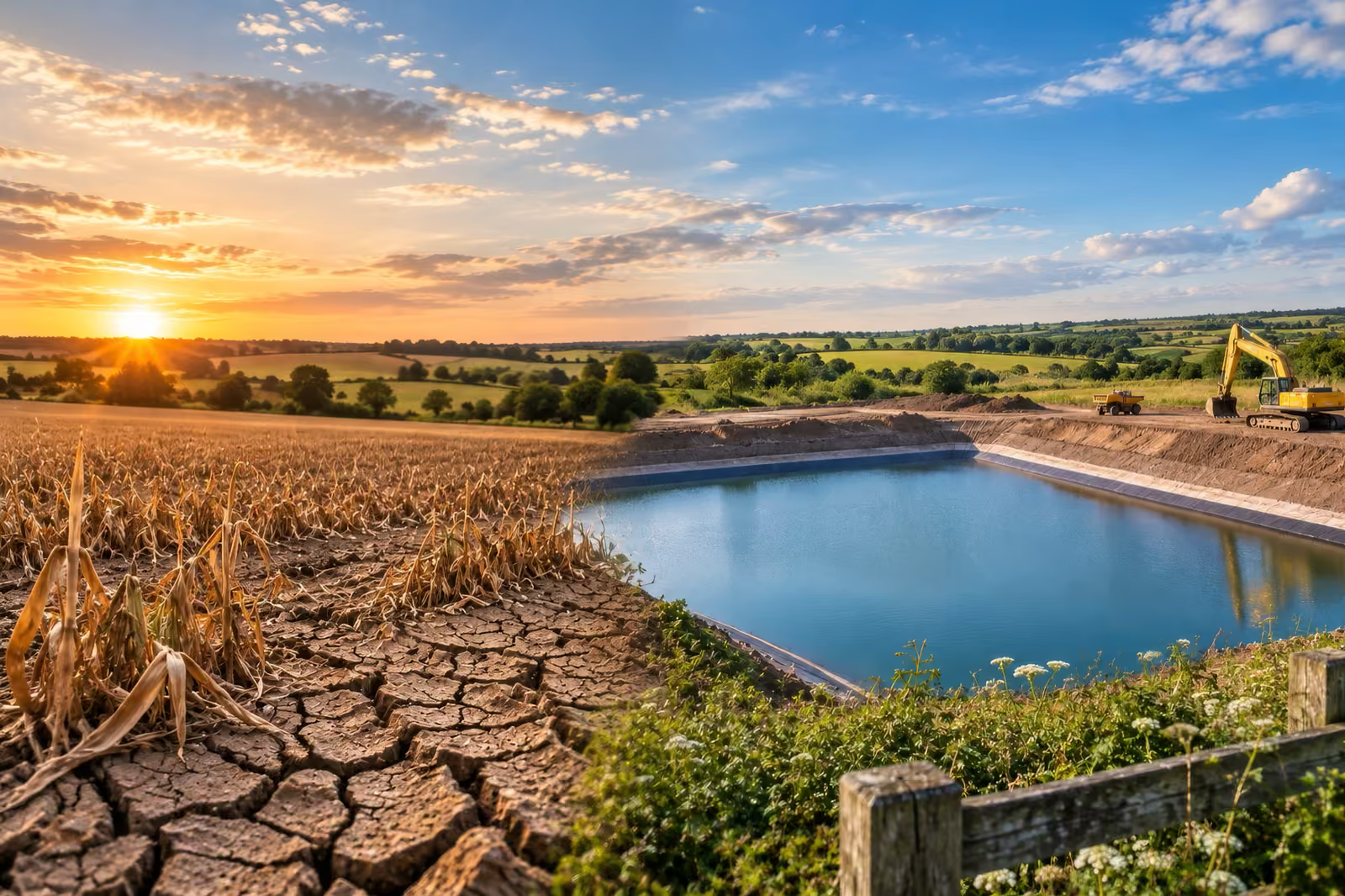
When Water Runs Short: What Does It Mean for British Food Security?
British farmers are no strangers to adapting.
Weather, markets, regulation, input costs and changing consumer demands have always required farming businesses to evolve. But the summer of 2026 has brought one particular challenge sharply into focus: water.
England recorded its driest July since records began in 1836, receiving just 6.5mm of rain, around 10% of the long-term average for the month. By late August, reservoir storage across England had fallen to 59.8%, 18.2% below the level normally expected at that time of year.
At one stage, more than two-thirds of England was in drought.
For agriculture, these aren't simply statistics about an unusually dry summer. They raise a much bigger question about our ability to produce food reliably in the years ahead.
From water security to food security
Water is fundamental to food production.
It grows crops, irrigates fruit and vegetables, supports livestock and enables many of the day-to-day processes on which farming businesses depend.
When water becomes scarce, the consequences quickly work their way through the food chain.
The Environment Agency reported reduced crop yields, pressure on livestock forage supplies and increasing restrictions on abstraction for irrigation during this summer's drought. The UK salad season also finished earlier than normal, increasing reliance on imports.
Harvest figures tell a similar story. AHDB reported wheat yields around 12% below the five-year average by late August, while individual cereal growers in some areas reported reductions of up to 30%.
The Energy & Climate Intelligence Unit (ECIU) went further, estimating in August that the 2026 arable harvest could be one the smallest since comparable records began in 1984.
Lower yields ultimately mean less produce to sell and less income coming back into farming businesses. They can also contribute to pressure further along the supply chain, including food availability and prices.
That creates an uncomfortable cycle: the very businesses being asked to invest in greater resilience can find themselves with less money available to make that investment.
Farmers will adapt but they need the tools to do it
If there is one thing agriculture has demonstrated repeatedly, it is its ability to adapt.
That doesn't mean simply accepting lower yields. It means looking hard at where inefficiencies exist and considering how farming systems, infrastructure and cropping choices may need to change.
Technology will undoubtedly be part of that.
More accurate irrigation, soil moisture monitoring, precision agriculture, better soil management and improved water capture and storage can all help businesses make better use of the water available to them.
We may also see changes in what Britain grows.
Researchers are already exploring the potential for crops such as chickpeas and other pulses to become more commercially viable in the UK as our growing conditions change. Crops including fava beans and soya may also form part of increasingly diverse rotations.
This isn't about abandoning the crops we have traditionally grown. It is about asking whether a more diverse farming system can spread risk and make individual businesses more resilient to increasingly variable conditions.
But adaptation requires investment, and farmers cannot make that transition alone.
Is water infrastructure keeping pace?
The NFU has been clear that farmers and growers need secure and reliable access to water if Britain wants a resilient domestic food supply.
Among the measures it has called for are more flexible abstraction licences so that water can be taken and stored when it is plentiful; a quicker and more consistent planning system for farm reservoirs; clearer local communication about restrictions and water availability; and a risk register identifying vulnerable business water users, particularly livestock, poultry and high-value horticultural businesses.
It has also called for further rounds of the Water Management Grant to help businesses invest in infrastructure.
There has been some movement from government.
In August, the government announced up to £15 million of funding for on-farm reservoirs alongside changes intended to reduce planning barriers. The Environment Agency has also been instructed to prioritise requests for short-term variations to abstraction licence conditions during drought, with work underway to simplify applications for longer-duration abstraction licences for reservoirs.
These are welcome developments. But the bigger issue is whether water for food production is being treated as strategically as the scale of the challenge requires.
Storing today's water for tomorrow's food
That question will be taken directly to policymakers on 17 November, when representatives from UK fruit and vegetable growing, alongside Morrisons and Harper Adams University, take proposals on agricultural water resilience to the House of Lords.
The group is calling for agricultural water storage to be recognised as strategic infrastructure.
The principle is relatively straightforward: when water is plentiful, farmers need the ability to capture and store more of it so that it is available during prolonged dry periods. They are also calling for food production and food security to be given greater prominence when decisions are made about how water is allocated.
That matters because agriculture isn't the only sector competing for a finite resource. Households, industry, development and the natural environment all have legitimate water requirements. The challenge is creating a system capable of balancing those demands while recognising that without water, we cannot produce food.
The danger of simply importing the problem
When domestic production falls, importing more food can appear to be the obvious answer. But greater dependence on imports does not remove climate risk. It potentially transfers that risk elsewhere.
Many of the countries from which Britain imports food are facing their own challenges from heat, drought, flooding and water scarcity. Relying increasingly on overseas production therefore leaves UK consumers exposed to weather events, supply disruption and price volatility beyond our borders.
Food security isn't about Britain producing everything it consumes. That would neither be realistic nor necessarily desirable.
It is about maintaining a strong, productive domestic farming sector alongside a diverse and resilient supply chain, and water security is becoming an increasingly important part of that equation.
Adaptation needs to happen on both sides of the farm gate
Farmers will continue doing what they have always done: adapt.
There will be opportunities to improve efficiency, embrace technology, rethink rotations, improve soils, capture more water and consider crops and farming systems better suited to changing conditions.
Every farming business should be asking where its own vulnerabilities lie and what practical steps could make it more resilient.
But there is a limit to what can be achieved at individual farm level.
If government wants British agriculture to invest for the future, the policy and planning environment must enable that investment. Reservoirs cannot take years to navigate planning. Water that could have been stored during periods of abundance should not be lost because licences lack flexibility. And businesses being encouraged to invest in new technology need confidence that producing food in Britain remains a strategic priority.
The summer of 2026 has provided a stark reminder that water cannot be taken for granted.
The question now is whether we treat it as another difficult season to get through, or use it as the catalyst to modernise, remove inefficiencies and build a more resilient farming system.
Because ultimately, water security and food security are becoming increasingly difficult to separate.