
What Could a New Prime Minister Mean for British Farming?
The arrival of Andy Burnham as Prime Minister brings another change at Westminster at a time when British agriculture is already dealing with considerable uncertainty.
From prolonged dry weather and rising costs to changes in agricultural support and inheritance tax, there is no shortage of issues competing for farmers’ attention. So, what has the new Prime Minister said about farming so far, and what might the industry be watching over the coming months?
Food security moves up the agenda
One of the clearest messages from Andy Burnham since taking office has been around the importance of domestic food production.
During a visit to a farm in Cornwall in August, the Prime Minister spoke about food security in the context of national security and said that farmers should not be expected to carry the risks associated with a changing climate alone.
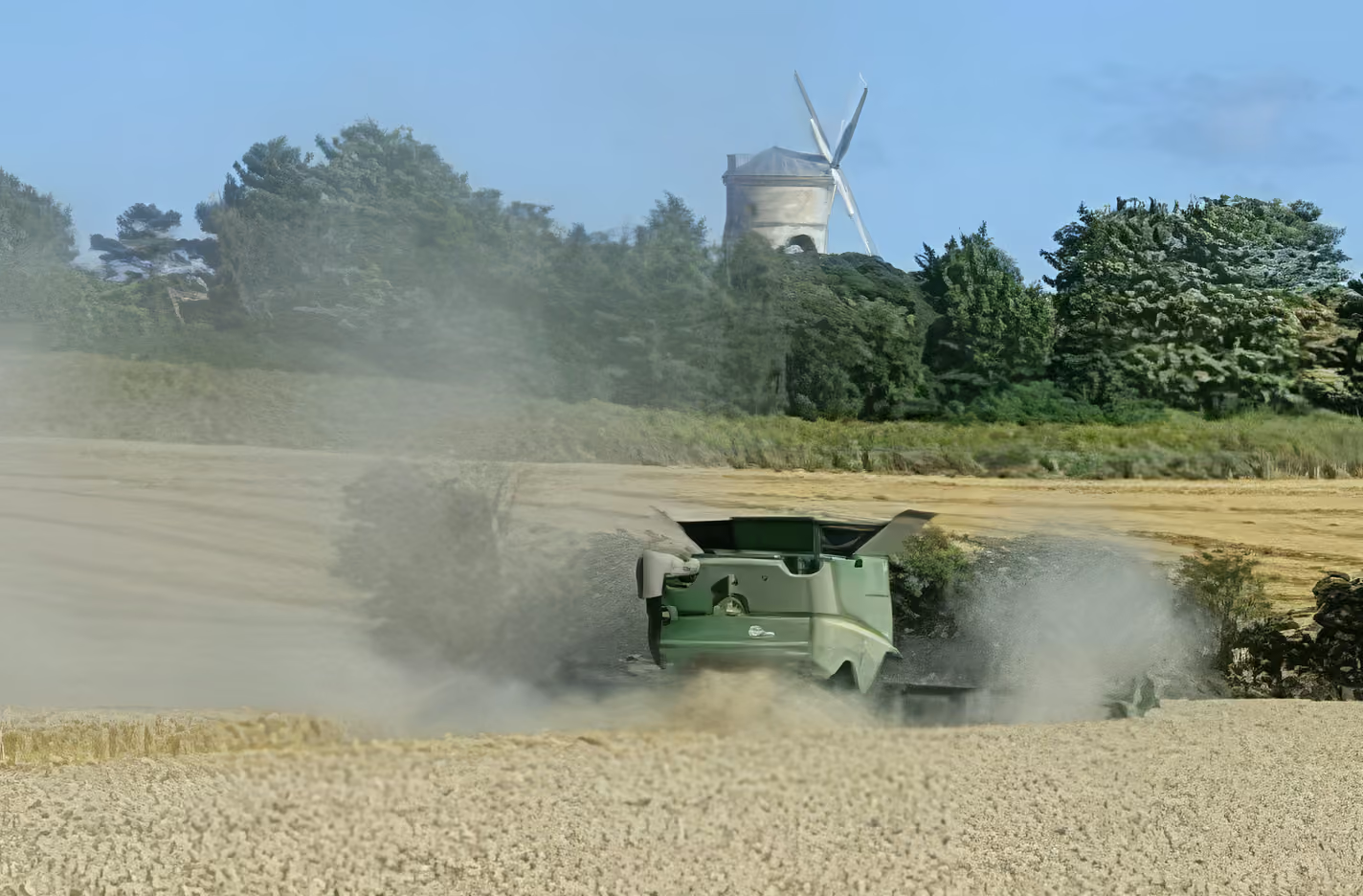
The visit came after an exceptionally hot and dry summer, with drought affecting large parts of England and putting pressure on crops, livestock, water supplies and winter fodder reserves.
For an industry which has repeatedly called for greater recognition of its role in national food security, the language will certainly be of interest. The question will be how far that recognition translates into longer-term agricultural policy.
£65 million drought support announced
The Government has announced a £65 million package for English farmers affected by this summer's drought.
Of this, £50 million is being directed into the 2026 Sustainable Farming Incentive, while £15 million has been allocated to supporting on-farm water storage and reservoir projects.
Other measures include greater flexibility around environmental schemes and water abstraction, together with proposals to simplify the process for farmers wanting to construct reservoirs.
The intention is not only to provide assistance following this year's conditions, but also to improve the resilience of farms to future periods of drought and extreme weather.
The NFU described the package as an "important step" towards improving water and food resilience and said that a number of measures it had been calling for had been recognised.
However, farming and rural organisations have also pointed out that the package cannot address all of the challenges created by this year's conditions. For individual businesses experiencing significantly reduced yields, additional feed requirements or increased irrigation costs, the financial impact of the drought may continue well beyond harvest.
Resilience – but also profitability
Alongside managing the immediate consequences of the weather, there is a wider debate taking place about what a resilient British agricultural sector actually looks like.
Investment in reservoirs, water management, soil health and environmental measures can all contribute to resilience, but farms also need to be commercially sustainable enough to make those investments.
As discussed last month, the Government's longer-term direction for English agriculture has already placed emphasis on farming becoming profitable, productive, sustainable and resilient.
Finding the balance between those four objectives is likely to remain one of the central challenges for agricultural policy.
Farm businesses need sufficient confidence in future support, regulation and markets to make long-term decisions – whether that is investing in machinery, changing cropping systems, improving water infrastructure, taking on staff or planning for succession.
Inheritance tax remains a key issue
One subject that has certainly not disappeared with the change of Prime Minister is inheritance tax.
Changes to Agricultural Property Relief (APR) and Business Property Relief (BPR) took effect in April 2026. Under the revised arrangements, qualifying agricultural and business property can receive 100% relief up to £2.5 million, with 50% relief applying above that threshold. Unused allowance can also be transferred between spouses or civil partners.
Despite revisions to the original proposals, farming organisations continue to raise concerns about the effect the changes could have on family farming businesses and succession planning.
Industry representatives are now calling on the new Prime Minister and Chancellor to reconsider the policy, making the Autumn Budget an important date for the agricultural sector.
Whether further changes will be made remains to be seen.
What happens next?
It is still very early in Andy Burnham's premiership, and it would be premature to draw conclusions about what his Government will ultimately mean for British farming.
The early statements have put food security, climate resilience and farm profitability into the conversation, while the drought package represents one of the first tangible agricultural measures announced under the new administration.
At the same time, significant questions remain.
Farmers will be looking for greater clarity around future agricultural support, taxation and succession, water infrastructure, planning, regulation and the wider conditions needed to maintain profitable domestic food production.
The Autumn Budget should provide another indication of the Government's direction.
For now, perhaps the most important development is that food production and the resilience of British agriculture are firmly on the political agenda. We will all be watching closely to see what follows.