
England's First Land Use Framework: What It Means for Farmers Like You
In March 2026, the Government published something long overdue: England's first ever Land Use Framework. After years of consultation and several false starts, this landmark document sets out a national vision for how our finite land should be used, balancing food production, nature recovery, clean energy and housing. For farmers and rural businesses, it carries real implications. Here's what you need to know.
So, What Actually Is the Land Use Framework?
Put simply, it's a blueprint for how England's roughly 130,000 square kilometres of land can be managed more effectively. For too long, decisions about where to build homes, generate energy, restore habitats and grow food have been made in isolation, without any joined-up, national strategy. The Framework changes that.
It has three main components: a long-term vision for England's landscapes out to 2030 and 2050; a set of principles to guide land use decision-making; and a package of actions the Government will take, in partnership with farmers, landowners, developers and communities, to support change on the ground.
Crucially, it argues there are no 'false choices' here. According to the Government's own analysis, England has enough land to deliver on its goals for nature restoration and development without reducing domestic food production. The key is making our land work smarter, not choosing between competing uses.
What Does It Mean for Farming?
The Framework makes a clear, long-term commitment: the amount of food England produces will be maintained. The most productive agricultural land will be safeguarded, and sector plans will be developed to underpin food security and drive economic growth. This is welcome news at a time when farmers have faced considerable uncertainty.
Beyond that headline commitment, here's what the Framework specifically offers farmers:
- Better data and planning tools to help future-proof farm businesses against extreme weather and market shocks, particularly relevant after one of the wettest winters on record.
- Greater rights and certainty for tenant farmers, who manage a third of England's farmland, including a reformed Farm Tenancy Forum.
- Simplified payment systems and digitised land data submissions to reduce the administrative burden of working with Government.
- A commitment to optimising incentives so that financial support for farmers genuinely delivers for both nature and food production, not one at the expense of the other.
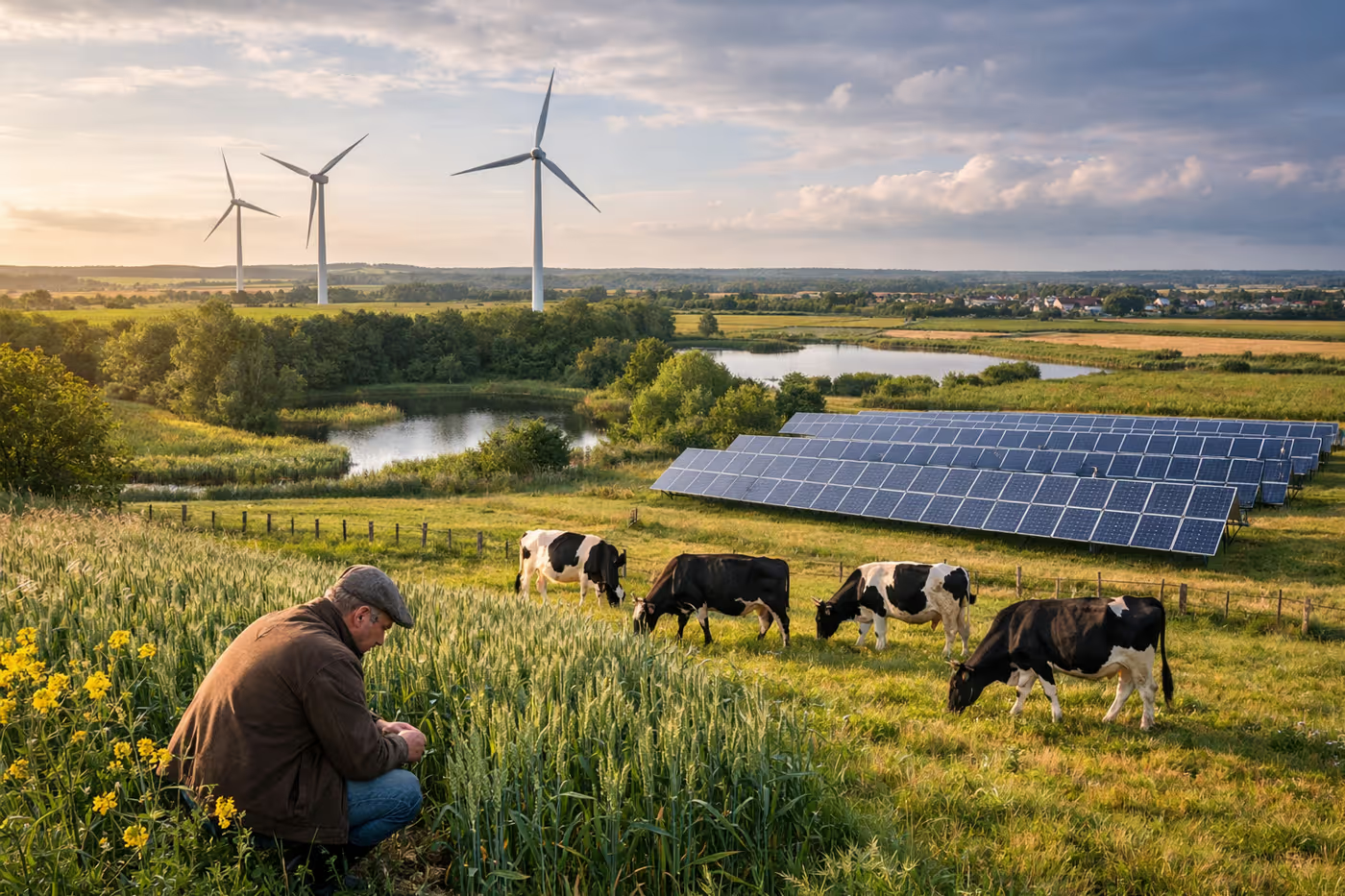
The Framework also recognises that most land use change isn't about taking land out of agriculture entirely, it's about making land more multifunctional alongside food production. Think agroforestry, hedgerow restoration, cover cropping, and peatland management sitting alongside productive fields.
Nature Recovery and the 30by30 Commitment
England is one of the most nature-depleted countries in the world, that's not an opinion, it's a documented fact. The Framework sets a clear pathway to nature recovery, supporting the Government's 30by30 commitment: protecting 30% of land and sea for nature by 2030. Local Nature Recovery Strategies will identify where habitat restoration is most needed, and biodiversity net gain requirements mean development must leave the natural environment in a measurably better state.
By 2030, the vision includes 350,000 football pitches' worth of new wildlife-rich habitat. By 2050, woodland cover is expected to increase to 16.5%, up from current levels, with rivers running cleaner and fewer homes built in flood-risk areas. Nature recovery and farming aren't mutually exclusive here; they're presented as complementary.
Clean Energy and the Land Question
The Framework addresses one of the more heated debates in rural areas: the expansion of solar and wind energy on farmland. The Government's position is that solar and wind will continue to make up only a small proportion of overall land use, even as the UK targets at least 95% of electricity from clean power sources by 2030. Where energy generation does occur on agricultural land, the expectation is that much of it will be managed sustainably for dual purposes, for example, agrivoltaics, where solar panels and crops or livestock share the same land.
Housing and Planning
The Framework will also play a role in steering the Government's target of 1.5 million new homes to the most suitable locations, away from floodplains, and away from the best and most versatile agricultural land. By opening up access to high-quality spatial data, planners and developers will be better equipped to make decisions that protect farmland while unlocking growth elsewhere.
Making Land Digital
One of the Framework's more practical commitments is what the Government calls 'making land digital'. This means sharing environmental datasets and mapping systems so that communities, farmers, landowners and developers have access to world-class data. The aim is to reduce fragmented decision-making and give everyone involved in land management a clearer picture of what's where, and what it could be used for.
What Happens Next?
This is the first iteration of the Land Use Framework, it won't be the last. The Government has committed to updating it every five years to reflect progress and incorporate evolving data and evidence. Over the next year, a dedicated Land Use Unit will be established to drive delivery, align national and local plans, and ensure England's landscapes deliver for development, food production and nature recovery together.
For farmers, the Framework represents both an opportunity and a responsibility. It provides a clearer policy landscape in which to make long-term investment decisions, while acknowledging the central role agriculture plays in feeding the nation, managing the countryside, and delivering environmental outcomes.